



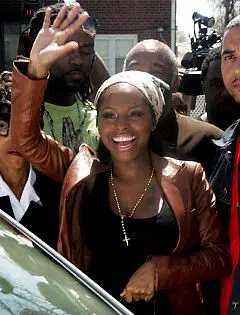
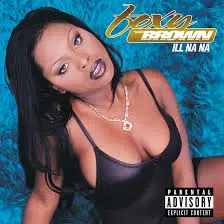
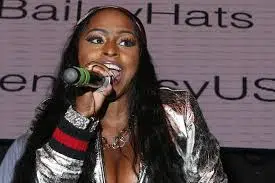
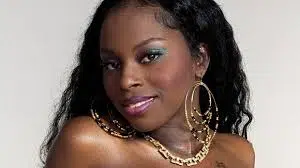
Inga DeCarlo Fung Marchand (born September 6, 1978),[nb 1] better known by her stage name Foxy Brown, is an American rapper.[6] After signing to Def Jam in 1996, she released her debut album, Ill Na Na, later that year on November 19, 1996. The album was certified platinum by the RIAA and has sold over 7 million copies worldwide. She was also part of the hip hop supergroup the Firm, along with Nas, AZ and Cormega (who was later replaced by Nature). The Firm’s sole album arrived in 1997 and was released by Dr. Dre‘s Aftermath Entertainment. In 1999, her second album Chyna Doll, debuted at the top of the Billboard 200, making her the second female rapper to top the chart after Lauryn Hill in 1998.
Her third album Broken Silence, was released in 2001, which featured the Grammy-nominated track “Na Na Be Like”.[7] In 2003, she left Def Jam and canceled the release of her Ill Na Na 2 album, but returned in 2005 once Jay-Z, then the label’s president and CEO, signed her again to begin work on another unreleased album titled Black Roses. Her mixtape Brooklyn Don Diva was released in May 2008, and her visual album, King Soon Come, was slated for 2019 release but has been delayed indefinitely.[
Marchand is a Trinidadian-American of Dougla (mixed Afro-Trinidadian and Indo-Trinidadian) and Chinese-Trinidadian descent.[12] She and her two older brothers grew up in Park Slope, a middle-class neighborhood in Brooklyn. Her parents divorced when she was four, and her family moved in with her maternal grandfather.[13] She later attended Brooklyn College Academy.[13]
Musical style[edit]
Brown’s lyrics have been described to be “raunchy” and “over-the-top” with “skimpy clothes to match.”[55] Her music is often centred around themes such as “fashion, sex, and the mafia” and is described as “intriguingly seductive” and having “a contemporary edge with a sleek and sexy soundscape.”[56] Her work for her debut album was described as “a heroine straight from the pages of a James Bond novel,” selling over a million copies with the support of major male artists such as Nas and AZ.[56] Brown’s voice has been described as a “husky flow” with “dancehall swagger”.[51]
Although her work was compared to rapper Lil’ Kim, Highsnobiety writer David Opie said that,
Just because they were both the ‘First Ladies’ of their respective crews, doesn’t mean that Foxy or Kim were identical by any means, and it was hugely misogynistic to suggest otherwise […] In an industry that still actively mocks vulnerability and weakness, hip hop needs more rappers who are willing to open up in this way, and the fact that Foxy did so such a long time ago speaks volumes about her artistry.[51]
Influences[edit]
Brown has cited Nas, MC Lyte and Salt-N-Pepa as her influences.[57] It was these musical influences that helped Brown to make Broken Silence, “her most adventurous offering to date, dipping in and out of exotic sounds”.[56]
Legacy
Brown’s impact on the rap world has often been overlooked due to her legal run-ins, but it has been noted that “she’s bright, talented, sexy and, most important, she’s not afraid to take risks creatively” and that her “impact still stands.”[58][51] Her albums have been cited to harness “a winning formula of looping R&B songs into hip-hop hits, resulting in the genre-shifting record,” Ill Na Na.[59] The release of her album marked a monumental moment in hip-hop history, but was downplayed due to comparisons between her and rapper, Lil’ Kim and although Foxy may not have achieved the “iconic status” Kim had reached, “her debut album was an essential part of a turning point in mainstream rap music.”[60] Rolling Stone author, Kathy Iandoli stated,
In seeing Foxy … release [Ill Na Na] it was a reassurance that skills paid off; it didn’t really matter who was helping with the rhymes. It was the delivery and the content that was being said, and whose mouth it was coming out of. It was just a reassurance to me as a hip-hop head that this space might be opening up for women in a way that has never been done before. There was something about what [she] said and how [she was] saying it, that was hinting that a huge change was about to come.[61]
Cited as a fashion icon, Elle writer Janelle Harris wrote that Brown celebrated “the beauty of her mahogany skin as the self-professed ‘dark-skinned Christian Dior poster girl,’ boasted about being ‘dripped in Gabbana […] starring in billboards as big as the pride of the Black girls who saw themselves in her likeness.”[62]
Described as one of the “illest to ever do it – regardless of gender,” Scott Glaysher of HipHopDX noted that “If those aforementioned male rappers epitomize the menacing New York City mobster of the late 90s then Foxy represents the mob wife that is even more sinister with weaponized sexuality.” He stated that “the sheer confidence and astute rhyming Foxy brought to Ill Na Na, makes it one of the 90s most memorable albums and a catalyst for the fierce feminine rap wave that followed.[63] In 2020, Spin ranked her at 20, as one of the 30 Best Female Rappers Ever.[64]
Brown’s sophomore studio album Chyna Doll debuted at number one in 1999, making it only the second female rap album to debut at the top spot after The Miseducation of Lauryn Hill in 1998 by Lauryn Hill and eventually joined by Let There Be Eve…Ruff Ryders’ First Lady in 1999 by Eve, Pink Friday: Roman Reloaded in 2012 by Nicki Minaj and Invasion of Privacy in 2018 by Cardi B.[65][66][67][68][69] Her work has been paid homage to by numerous artists including, Nicki Minaj,[70] Kash Doll,[71] Bia,[72] Ivorian Doll,[73] Megan Thee Stallion[74] and Maliibu Miitch.[75] Minaj has even gone so far to say that without Foxy she “may have never even started rapping” and that she is “the most influential female rapper.”[76]































Comments